Description
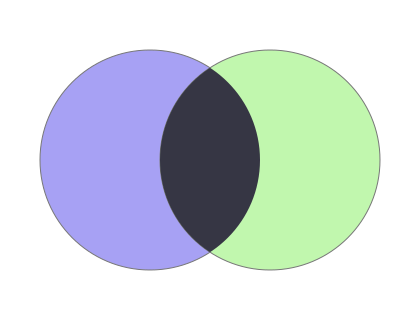
Why?
Machines can now make pictures, music, and stories. But are they really creative? Or are they just copying us?
MishMash is a big Norwegian research centre where scientists and artists team up to find out. We build new computer programs that can learn and solve problems, a bit like how you learn from practiceAI is short for artificial intelligence: computer systems that do things we usually think need human thinking, such as recognising pictures, writing text or composing music, mostly by learning from large numbers of examplesan umbrella term for computational systems that perform tasks associated with intelligence, from hand-written rule-based systems to today’s learning-based models. The Norwegian national AI strategy defines AI systems by what they do: act, physically or digitally, on interpreted data in order to reach a goal, with some systems adapting to how earlier actions affected their surroundings systems that people can make things with, we try them out in music, art, school, and games, and we ask the hard questions: Who owns a song made by a machine? Is it fair? Is it fun?
Computers can now produce images, music, and text that look and sound as if people made them. Systems like these are often called computer programs that can make new pictures, music or stories on their ownmachine systems that can produce results that are both novel and meaningful — not just random, and not just copiesmachine systems whose output is novel and meaningful and can stand on its own without a human finishing it (de Vries 2020). The term describes what the systems produce, not a claim that they are creative in Boden’s sense; whether they are, and how their output differs from human creativity, is one of MishMash’s research questions, and they are changing how we create and experience culture.
MishMash brings together researchers and artists from all over Norway to understand these systems: what they can and cannot do, how people can create together with machines rather than being replaced by them, and what this means for jobs, schools, health, and culture. We believe artists and creative researchers are especially well placed to explore AI critically and responsibly.
MishMash studies AI from the perspective of the fundamental human trait of creativity, understood here as the ability to form novel and meaningful ideas or works (Boden 2004). Human creativity has both shaped and been shaped by technological developments. Today, human creativity faces unprecedented challenges and opportunities brought by Creative AI, understood here as machine systems that can produce novel and meaningful results that stand independently (de Vries 2020). This raises several important questions: to what extent are Creative AI systems genuinely creative, how do they differ from human creativity, and how can humans and machines be co-creative? Furthermore, what are the societal implications of Creative AI, how will producers’ and consumers’ attitudes towards AI-generated creative content develop, and how can creative approaches to AI have an impact beyond the cultural and creative sectors?
We view artistic exploration as a pivotal entry point for engaging in critical discussions about AI and its implications for human-machine interaction and society. Artistic research has been integral to computer-based AI development since the early days of computer science (Colton and Wiggins 2012), exemplified by early rule-based systems for music composition (Miranda 2021) and painting (Cohen 1995). Today, learning-based systems can produce all sorts of artistic products, and several have become popular commercial products, such as Dall-E (images), ChatGPT (text), and Suno.ai (music).
MishMash aims to expand current knowledge and pioneer new CoCreative AI systems that allow partnerships between humans and machines (Anscomb 2024). We believe researchers and practitioners from creative disciplines are uniquely positioned to develop AI-based technologies and to do so responsibly, reflecting on their ethical challenges and potential drawbacks.
There are many possibilities with Creative and CoCreative AI systems, but also numerous challenges and knowledge needs:
- Challenge 1: How can we design and implement real-time AI systems for immersive, dynamic, and ethical human-machine collaborations in artistic performances?
- Challenge 2: How can artists integrate AI into their creative processes while maintaining control and addressing biases, cultural implications, and environmental impact?
- Challenge 3: How can AI-generated content and Creative AI systems impact health and well-being, and be integrated into therapeutic practices while considering empathy, consent, and equity?
- Challenge 4: How can Creative AI be integrated into education to enhance learning and foster AI literacy while considering diversity, justice, inclusion and well-being?
- Challenge 5: How can AI enhance innovation in the creative and cultural industries while addressing copyright, rights management, ethical challenges, sustainability, and equitable revenue distribution?
- Challenge 6: How can AI enhance the preservation, accessibility, and representation of cultural heritage in archives, libraries, and museums while ensuring ethical and legal compliance?
- Challenge 7: How can Creative AI enhance human agency, control, and expression in problem-solving while adhering to physical, legal, and societal constraints during the creative process?
MishMash’s primary objective is to create, explore, and reflect on AI for, through, and in creative practices, guided by the overarching research question: What are the possibilities, limitations, and transformative effects of AI on creative practices, and how can we develop CoCreative AI systems that complement human creativity while addressing ethical, cultural, and societal implications?
How?
More than 200 researchers and artists from all over Norway work together in MishMash. They meet online every week and do three things:
- CREATE: build new AI tools and artworks
- EXPLORE: try AI out in concerts, classrooms, hospitals, and museums
- REFLECT: think carefully about what AI does to people and society
The work is split into seven teams, called a team working on one part of a big projecta work package is research-speak for a team of people working on one part of a big projectthe unit of organisation in a research project: a defined set of tasks, people and results with its own leadership. MishMash has seven, WP1 to WP7, each built around one of the centre’s themes; the abbreviation WP is used throughout the site, each looking at AI from a different angle.
MishMash gathers more than 200 researchers and practitioners from the arts, humanities, social and natural sciences, design, and engineering. The centre is a lively, mostly virtual research environment with weekly online meetings, public workshops, and regular symposia with lectures, performances, and exhibitions.
The work follows three interconnected approaches:
- CREATE: making AI-based systems, tools, and artworks
- EXPLORE: using AI in creative practice, and creative methods in other fields
- REFLECT: critically studying the impact of AI on people, culture, and society
MishMash will bring together a large multidisciplinary and cross-sectoral group of researchers and practitioners from the arts, humanities, social and natural sciences, design, and engineering. MishMash organises its theoretical and methodological “mishmash” into a structured “mesh,” where projects and activities intersect across themes, approaches, and perspectives.
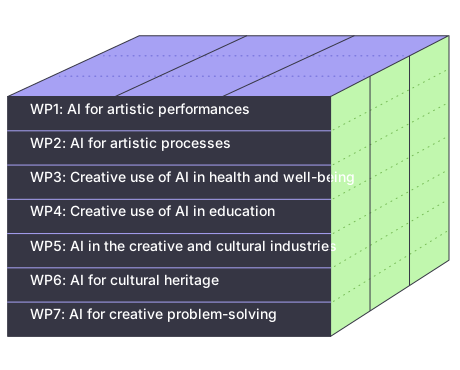
The WPs are designed around seven core themes, addressing the challenges outlined in the previous section. While some WPs focus on leveraging AI in creative—primarily artistic—applications, others explore the innovative use of AI in adjacent domains, fostering a dynamic interplay between art, science, and society. The work will be conducted by combining a multitude of scientific and arts-based theories and methods, which can be summarised in three interconnected research approaches:
- CREATE: making AI-based systems, tools, artworks, and related frameworks and policies. This includes theories and methods from computer science, engineering, and various types of art and design, emphasising creating CoCreative AI systems that prioritise human agency, environmental sustainability, and democratisation of AI technologies.
- EXPLORE: using AI-based systems in creative practice and seeing how creative methods can be applied in other domains. This includes investigating how AI can enhance creativity, foster innovation, and support learning and well-being using theories and methods from psychology, therapy, educational sciences, and cultural heritage.
- REFLECT: critically studying and discussing the impacts of AI on humans, human creativity, various cultures, and society at large. This includes theories and methods from the humanities and social sciences to ensure responsible AI development and use.
The centre will be a lively, virtual research environment, with weekly online meetings, biweekly work package check-ins, monthly thematic seminars, regular public workshops, life-long learning events, and bi-annual symposia with lectures, performances, and exhibitions.
What?
The seven teams:
- WP1: concerts and art shows where humans and machines perform together
- WP2: how artists can use AI in film, games, music, and pictures
- WP3: using creative AI to help people feel better
- WP4: AI in school, learning with it and about it
- WP5: fair rules and fair pay when AI is used in music, film, and media
- WP6: using AI to explore old songs, pictures, and archives
- WP7: AI that helps people solve tricky problems, from design to emergencies
The centre’s research is organised in seven work packages:
- WP1: AI for artistic performances: live music and art where humans and machines improvise together
- WP2: AI in artistic processes: how AI changes the way visual art, film, music, and games are made
- WP3: Creative use of AI for health and well-being: AI-supported arts therapies and well-being
- WP4: Creative use of AI in education: teaching materials and AI literacy for schools and lifelong learning
- WP5: AI in the Creative and Cultural Industries: copyright, business models, and sustainability
- WP6: AI for cultural heritage: opening up archives, libraries, and museums with AI
- WP7: Human-centric AI for Creative Problem-Solving: AI that supports people solving practical problems
-
WP1: AI for artistic performances: Focus on real-time, multi-agent and embodied AI (Martin et al. 2020) for live music, art and interactive installations, emphasising continuous interaction between humans and machine agents (Dahlstedt 2021) in live co-creative improvisation (Erdem et al. 2022; McCormack et al. 2020). Counters the trend of very large, hard-to-control models by balancing data-based approaches with artists’ knowledge and search-based methods (Jónsson, Erdem, and Glette 2024), and asks what must be “explainable” when interacting with AI during performance (Bryan-Kinns et al. 2024).
-
WP2: AI in artistic processes: Study how generative and prompt-based AI integrate into production workflows across visual arts, film, VR/XR, music and games, including the effects of “outsourcing” creative decision-making and the hegemonic cultural biases in many commercial tools (Vinchon et al. 2023). When AI systems reinforce dominant cultural patterns they risk narrowing public discourse and diminishing cultural diversity (Vallor 2024); the WP develops artist-centred tools and practices that defend autonomy and address ethical and legal concerns.
-
WP3: Creative use of AI for health and well-being: Examine effects of AI-generated creative content and AI-supported arts therapies on mental and physical well-being, building on the evidence that engaging in creative processes promotes health (Fancourt and Finn 2019) while addressing concerns that AI use may devalue human qualities like empathy and autonomy (Abadi et al. 2023). Co-designs inclusive, disability-aware interventions and prioritises consent, equity and responsible therapeutic use.
-
WP4: Creative use of AI in education: Develop pedagogical materials, curricula and AI literacy resources (Long and Magerko 2020), with emphasis on Norwegian availability, to integrate Creative AI across formal and lifelong learning. Navigates the transformative opportunities and the pedagogical, ethical and practical issues that generative AI brings to education (Bozkurt et al. 2024), foregrounding ethics, inclusion, privacy and accessibility.
-
WP5: AI in the Creative and Cultural Industries: Investigate legal, ethical and environmental implications of training and deploying Creative AI, from copyright and moral rights to the ethics of training AI on artists’ work and voices without agreements (Blitz 2018), in a landscape where platforms, streaming and AI intensify disruption of business models and legal frameworks (Geiger and Iaia 2024). Proposes sustainable business and regulatory frameworks including rights infrastructures, with commercialization pathways and life-cycle (LCA) analysis of environmental impact.
-
WP6: AI for cultural heritage: Build hybrid AI models blending machine learning with musicology and cognition-based symbolic AI (Lartillot et al. 2022) for automated transcription, classification, interlinking and presentation of archives and collections, emphasising minority cultural expressions such as Norwegian folk music and Sámi joik. The public sector must lead so these capabilities are used ethically and inclusively (Huang et al. 2023), with policies that prevent exploitative uses while enhancing discoverability and rights tracking.
-
WP7: Human-centric AI for Creative Problem-Solving: Create goal-oriented Creative AI frameworks and interfaces that empower practitioners (designers, filmmakers, industrial operators, emergency responders) by supporting surprise, control and evaluation within practical constraints, from iterative prompt-based exploration (Lawton et al. 2023) to real-time collaboration with embodied AI (Paradise et al. 2023), while encoding physical, legal and ethical bounds such as realism constraints (Duan et al. 2022), and ensuring agency, transparency and transferability.
What has the centre undertaken?
Besides the research itself, MishMash has promised the Research Council five things:
- A national centre. One place where higher education institutions, research institutes and artistic research environments work together with cultural, public and private organisations, rather than competing.
- New knowledge and new tools. AI methods that are built for creative work and tried out in performances, exhibitions, classrooms, therapy rooms, industry and archives.
- Expertise in Norway. Around 100 faculty members working on creative AI, educating dozens of doctoral candidates and hundreds of students, with courses open to professionals outside academia.
- International collaboration. Adjunct professors from leading environments abroad, and researchers early in their careers moving in both directions.
- Ways of working across disciplines. Methods for collaboration between fields that rarely meet, from the arts to engineering, and between the public and private sectors.
The primary objective rests on five secondary objectives, which answer the goals set for the AI centres:
- Establish a national centre spanning the country’s higher education institutions, research institutes and artistic research environments, together with libraries, museums, broadcasters, companies and international partners. The centre is a lively, largely virtual research environment, with weekly online meetings, biweekly work package check-ins, monthly thematic seminars, regular public workshops and lifelong learning events, and symposia twice a year with lectures, performances and exhibitions.
- Generate new fundamental knowledge about AI and develop AI-based algorithms and tools that are applicable in creative practices. The tools are used in public performances and exhibitions, in educational and therapeutic settings, within the creative industries and for cultural heritage. Critical reflection on diversity, privacy, copyright and sustainability feeds back into an iterative development cycle, and into publications and policy guidelines.
- Build expertise in Norway through research projects involving around 100 faculty members working on creative AI. They educate dozens of doctoral candidates and hundreds of students, and provide lifelong learning for freelancers and professionals in the public and private sectors. See research training.
- Collaborate with leading research environments worldwide by hiring adjunct professors and supporting two-way mobility for researchers early in their careers, so that Norwegian research, education and innovation on AI become more international.
- Develop methods and strategies for interdisciplinary collaboration between fields that are usually kept apart. MishMash is the first centre at this scale in Norway to span disciplines from the “soft” to the “hard”, between art and science, and to work closely with both the public and the private sector.
How the centre publishes and shares what it produces is set out on the open research page, and how members are expected to treat each other in the code of conduct.
When?
The centre started in December 2025 and will run for many years. During 2026, new researchers are being hired across Norway, and the centre gets up to full speed from the autumn of 2026.
The plan is to formally start the centre in December 2025, recruit doctoral and postdoctoral fellows during the spring of 2026 and get up to full speed from the autumn of 2026.

Who?
MishMash is governed and managed by several organizational bodies, each with specific responsibilities and roles:
- Management: Day-to-day management and coordination of MishMash activities
- Work Package Leader Group: Leads of the seven scientific work packages
- Board: Governance and decision-making body
- Council: Strategic oversight and partner compliance
- Scientific Advisory Board: International scientific guidance and evaluation
- Stakeholder Board: Representatives from partner organisations and stakeholders
References
The text on this page draws on the MishMash project description (2025). Works cited:
- Abadi, M. A. et al. (2023). “The Turning Point of Civilization: Sociological Perspective toward Artificial Intelligence on Modern Humanity”. Simulacra 6(2). doi:10.21107/sml.v6i2.22808
- Anscomb, C. (2024). “AI: Artistic Collaborator?” AI & Society. doi:10.1007/s00146-024-02083-y
- Blitz, M. J. (2018). “Lies, Line Drawing, and (Deep) Fake News”. Oklahoma Law Review 71(1). available online
- Boden, M. A. (2004). The Creative Mind: Myths and Mechanisms. Routledge. doi:10.4324/9780203508527
- Bozkurt, A. et al. (2024). “The Manifesto for Teaching and Learning in a Time of Generative AI: A Critical Collective Stance to Better Navigate the Future”. Open Praxis 16(4). doi:10.55982/openpraxis.16.4.777
- Bryan-Kinns, N. et al. (2024). “Explainable AI and Music”. In: Artificial Intelligence for Art Creation and Understanding. CRC Press. doi:10.1201/9781003406273-1
- Cohen, H. (1995). “The Further Exploits of AARON, Painter”. Stanford Humanities Review 4(2). available online
- Colton, S. and G. A. Wiggins (2012). “Computational Creativity: The Final Frontier?” In: ECAI 2012. IOS Press. doi:10.3233/978-1-61499-098-7-21
- Dahlstedt, P. (2021). “Musicking with Algorithms: Thoughts on Artificial Intelligence, Creativity, and Agency”. In: Handbook of Artificial Intelligence for Music. Springer. doi:10.1007/978-3-030-72116-9_31
- de Vries, K. (2020). “You Never Fake Alone. Creative AI in Action”. Information, Communication & Society 23(14). doi:10.1080/1369118X.2020.1754877
- Duan, J. et al. (2022). “A Survey of Embodied AI: From Simulators to Research Tasks”. IEEE Transactions on Emerging Topics in Computational Intelligence 6(2). doi:10.1109/TETCI.2022.3141105
- Erdem, Ç. et al. (2022). “Tool or Actor? Expert Improvisers’ Evaluation of a Musical AI “Toddler””. Computer Music Journal 46(4). doi:10.1162/comj_a_00657
- Fancourt, D. and S. Finn (2019). What Is the Evidence on the Role of the Arts in Improving Health and Well-Being? A Scoping Review. WHO Regional Office for Europe. available online
- Geiger, C. and V. Iaia (2024). “Towards an Independent EU Regulator for Copyright Issues of Generative AI”. Auteurs & Média 2. doi:10.2139/ssrn.4914938
- Huang, R. et al. (2023). “Beyond Diverse Datasets: Responsible MIR, Interdisciplinarity, and the Fractured Worlds of Music”. Transactions of the International Society for Music Information Retrieval 6(1). doi:10.5334/tismir.141
- Jónsson, B. Þ., Ç. Erdem, and K. Glette (2024). “A System for Sonic Explorations With Evolutionary Algorithms”. Journal of the Audio Engineering Society 72(4). doi:10.17743/jaes.2022.0137
- Lartillot, O. et al. (2022). “Segmentation, Transcription, Analysis and Visualisation of the Norwegian Folk Music Archive”. Proceedings of the International Conference on Digital Libraries for Musicology. doi:10.1145/3543882.3543883
- Lawton, T. et al. (2023). “Drawing with Reframer: Emergence and Control in Co-Creative AI”. Proceedings of the 28th International Conference on Intelligent User Interfaces. ACM. doi:10.1145/3581641.3584095
- Long, D. and B. Magerko (2020). “What Is AI Literacy? Competencies and Design Considerations”. Proceedings of the CHI Conference on Human Factors in Computing Systems. doi:10.1145/3313831.3376727
- Martin, C. P. et al. (2020). “Understanding Musical Predictions With an Embodied Interface for Musical Machine Learning”. Frontiers in Artificial Intelligence 3. doi:10.3389/frai.2020.00006
- McCormack, J. et al. (2020). “Design Considerations for Real-Time Collaboration with Creative Artificial Intelligence”. Organised Sound 25(1). doi:10.1017/S1355771819000451
- Miranda, E. R. (2021). Handbook of Artificial Intelligence for Music: Foundations, Advanced Approaches, and Developments for Creativity. Springer. doi:10.1007/978-3-030-72116-9
- Paradise, A. et al. (2023). “RealTHASC — a Cyber-Physical XR Testbed for AI-supported Real-Time Human Autonomous Systems Collaborations”. Frontiers in Virtual Reality 4. doi:10.3389/frvir.2023.1210211
- Vallor, S. (2024). The AI Mirror: How to Reclaim Our Humanity in an Age of Machine Thinking. Oxford University Press. doi:10.1093/oso/9780197759066.001.0001
- Vinchon, F. et al. (2023). “Artificial Intelligence & Creativity: A Manifesto for Collaboration”. The Journal of Creative Behavior 57(4). doi:10.1002/jocb.597
This page adapts its content to different readers — an experiment in stretchtext and adaptive content run by the MishMash website project. Use the switcher at the top to change reading level, and see the glossary for key terms.