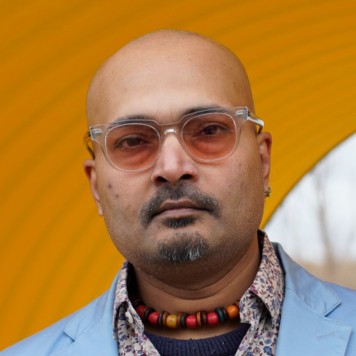
Budhaditya Chattopadhyay is a multidisciplinary artist, researcher, and writer. He is a Marie Curie Postdoctoral Fellow at the Faculty of Fine Art, Music and Design (KMD), University of Bergen, and a co-lead of the Work Package: AI in Artistic Processes, at the MishMash Centre for AI and Creativity.
In this chapter, the colonial intervention of the technologies of capture are examined in the Global South regions, especially in South Asia in the beginning of the twentieth century. I study the ramifications of this entry in the form of mutating everyday sounds and musical practices into commodified sound objects for industrialisation and sale. From a critical decolonial position, this introduction of the technologies of capture is read here as a precarious intrusion into the sounding and listening cultures of the Global Souths, and a moment of emergence of an extractive capitalism through the colonial routes that devastate the sonic symbiosis of the land.
Atomspheres is a series of performances on elemental listening engagement and meditative environmental attunement, leading to a participatory performance with the co-listeners. The performances attune to the macro-scale crises of the climate and ecology in a planetary context and bridges its intersection with micro-level coping strategies to the crises in a regenerative gathering. The performances resonate with the tradition of free improvisation as well as communal and participatory sonic gatherings for affective and discursive engagement with crises and conflict, practiced in many Global Souths cultures. These performance gatherings involve field recordings of climate variables like wind, water, and woods, comprovised by chance generative processes, accompanied by radio interferences transducing situated weather patterns, weaved together by meditative instrumental interventions of traditional instruments, as well as live electronics and algorithmic interpretation of data and assemblages embracing free improvisational techniques and ethos. As an invocation, the series invites the co-listeners into an exercise of slow listening and slow breathing that try to suspend time, control, ego, and individuality to tap into a humbler mode of fatalism and a distributed self-hood. This philosophical positioning stresses the subjugation of events or actions to fate or destiny and is commonly associated with an attitude of acceptance in the face of future events, which are thought to be inevitable. This approach manifests into yielding control by an emergent form of togetherness, intersubjectivity, and kinship when listening transcends an overt causality, and the psychosomatic condition embraces slow breathing to contemplate, and affective attunement. The project is inspired by the micro-level entanglements of human, more-than-human, and other life forms in a survival context, and explores sensory transduction of environmental conditions to figure how to make them post-immersive and attuning experiences in an openly circular, collaborative performance setting.
The research exhibition Archival Intelligence examines the roles of today’s all-pervasive digital technologies, such as Artificial Intelligence, in extracting data from archives and museums for profit.
Dhvāni means “resonance” in Sanskrit. Resonances between sounding objects and between people are the starting point for this installation by Indian-born artist and thinker Budhaditya Chattopadhyay. In STUK’s courtyard, a web is stretched with hundreds of Indian ceremonial bells and other instruments, such as wind chimes and ghungroos. By means of a self-built artificial intelligence system, this resounding network responds to human presence: footsteps, voices, hand clapping. Through machine learning, the interconnected system improves its performance over the six weeks of Hear Here, creating a beyond-human resonant organism. In this way, Chattopadhyay links ancient musical traditions with contemporary technologies, inviting visitors to listen empathetically and step outside their judgmental “ego”.