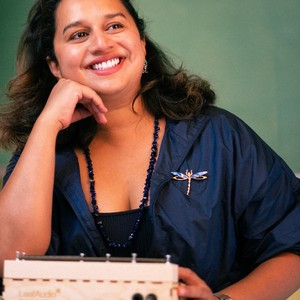
Tejaswinee Kelkar is a music technologist, teacher and vocalist. She is an associate professor in music technology at the University of Oslo. She teaches in the the Music, Communication and Technology masters program, and for bachelors in musicology. Her research interests are melodic cognition, motion-capture and musical-cultural analysis. Her doctoral thesis is here. Her research focus is on how aspects of melodic perception are illustrated through multimodality, and linguistic prosody.
Previously, she worked as a data analyst at Universal Music Norway, working with programming tools for business intelligence for Norway and reporting solutions for other territories. She also worked in the creation and development of an online virtual lab for teaching concepts of north indian music through the use of web audio, developing pedagogical tools and exercises for the web with the VLabs project. Her masters thesis was about gesturing and body movement in NICM, and clustering based spatial algorithms for raga display.
As a musician, she focuses on integrating her musical background with electronic at every stage from composing new material to developing actuated materials to amplify a disembodied voice. She is interested in understanding the use of the voice as a disembodied, and distorted object.
She trained in north indian classical singing from a young age, and later, western classical composition. In addition to being a vocalist, she plays the harmonium and other instruments.
This paper presents a live semi-autonomous system that co-improvises with a live musician using a model learned from the relationship observed in paired recordings of an improvising duo. This responsive system is based on a deep learning approach that models the relations between sequences of events produced by co-playing musicians in continuous time, using transformer models. We present the architecture for simultaneous sequences of sonic events and provide a quantitative evaluation on several representative tasks. Results are compared against a canonical transformer and a multichannel Factor Oracle, the latter being a widely used model for live sequence-based symbolic music generation. We detail a live implementation employing concatenative synthesis and introduce a customization procedure in which the generative model is iteratively retrained on curated, satisfactory sections from sound recordings of actual human-system co-improvisational interactions. This iterative fine-tuning enables the model’s stylistic output to diverge from the original training corpus. Two musical use cases demonstrate the application of this technique.
This paper presents LightHearted, an open-source Python framework for mapping the heart’s electrical activity from electrocardiography (ECG) signals acquired from performers to stage lighting in a concert setting. The aim is to provide dynamic lighting coupled to the physiological processes occurring during performance. Drawing upon critical approaches towards using biosignals in interactive systems and live concert research, we outline the framework’s design and implementation and present a case study with the Aarhus Symphony Orchestra. This paper highlights both technical and conceptual challenges of integrating biosensor-based lighting into a large-scale orchestral context. Results from a post-concert audience survey (N = 324) suggest that while responses to the lighting were mixed, it was generally not perceived as distracting and would be welcomed for use in future concerts.